


Hantaran Singapore 2026: Trays, Items, Costs and Display Guide

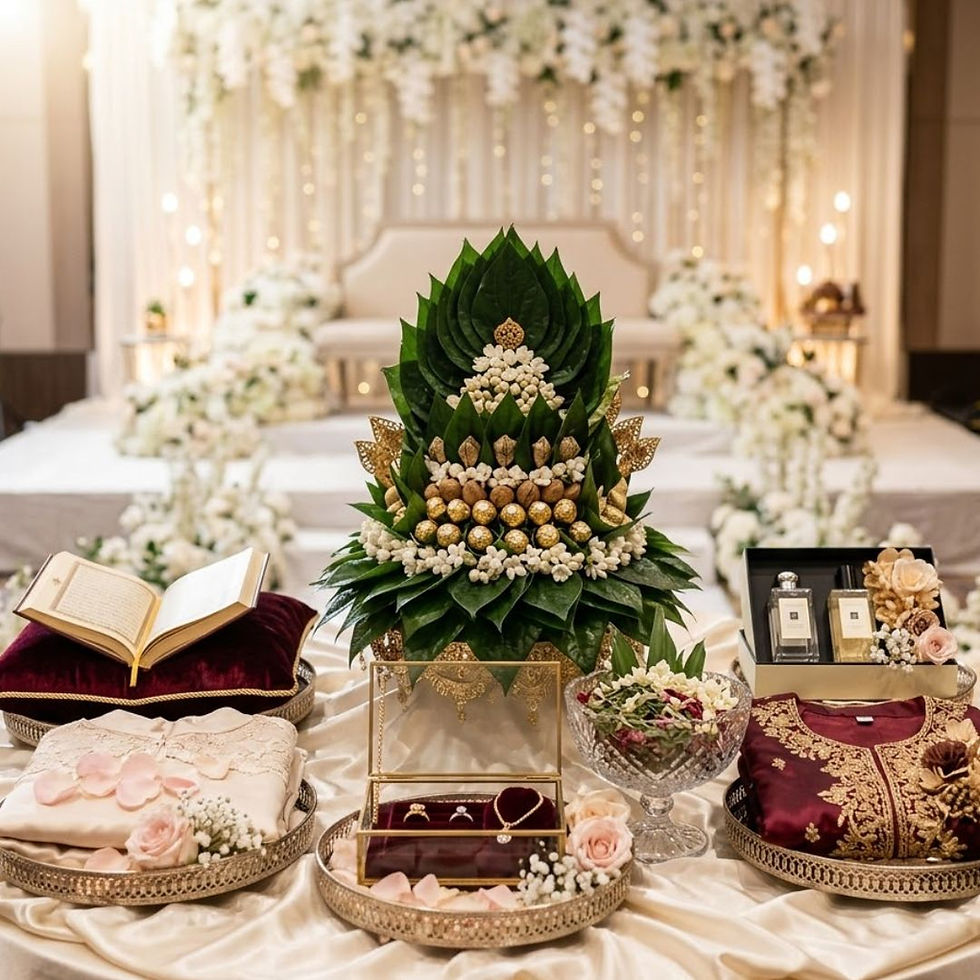
Hantaran defines every Malay wedding in Singapore. Yet most couples reach the akad nikah still unsure about three basic questions. How many trays they need. What each tray costs. Whether Islam even requires the practice. Singapore Muslims registered 5,184 marriages in 2024, according to the Singapore Department of Statistics. Almost every one of those couples exchanged hantaran. This guide covers the cultural rules and item lists for 5-, 7-, 9- and 11-tray setups. It includes verified 2026 cost ranges. It also shows how De Hall in Tai Seng displays hantaran inside its Tai Seng ballroom.
Key Takeaway
A 7-tray hantaran in Singapore costs S$675–S$11,400 in 2026, depending on tier. The figure covers tray decoration plus items inside. Wang hantaran (cash gift) sits separately and ranges S$6,000–S$15,000 based on historical Singapore data. Hantaran trays must always be odd numbers — 5, 7, 9 or 11. The bride traditionally returns two more trays than the groom. Mas kahwin remains compulsory under Islam; hantaran does not.
What Is Hantaran in a Singapore Malay Wedding?
Hantaran is the customary exchange of decorated gift trays between bride and groom during a Malay Muslim wedding. The trays carry symbolic and practical items presented during the akad nikah or bertunang ceremony. Crucially, hantaran is a Malay cultural practice — not an Islamic obligation. Most confusion among Singapore couples stems from blending hantaran with mas kahwin, which Islam treats very differently.
Hantaran Defined — Cultural Gift Exchange, Not Religious Duty
Hantaran refers to gift trays exchanged between two families during a Malay engagement or wedding. The tradition originates from Malay adat, not from Islamic law. Both families present decorated dulang (trays) carrying items chosen for symbolic, practical or modern reasons.
"Hantaran, a custom adopted from the Malay culture and not the Muslim religion, is a non-compulsory customary gift given by the groom to the bride's family," according to Kahwin.sg (2022). That ruling means couples can scale or modify hantaran freely. Skipping it entirely does not invalidate the marriage religiously.
However, hantaran carries significant social weight in Singapore Malay culture. Skipping it often signals financial difficulty or family disagreement. Most couples therefore practise hantaran in some form, even when budgets are tight.
Hantaran vs Mas Kahwin vs Mahr vs Wang Hantaran — The Definitive Comparison
Four overlapping terms confuse most Singapore couples planning a Malay wedding. Each carries a distinct religious status, recipient and purpose. Getting this distinction right matters for ROMM registration. The Registry of Muslim Marriages records mas kahwin and hantaran as separate fields.
Term | Religious Status | Who Receives | Singapore Amount |
Mas Kahwin / Mahr | Wajib (compulsory Islamic dowry) | Bride alone — her sole property | Minimum S$100 (Singapore) |
Hantaran (Barang) | Optional cultural custom | Exchanged between both families | Odd-numbered trays (5–11) |
Wang / Duit Hantaran | Optional cultural cash gift | Bride's family traditionally | S$6,000–S$15,000 (historical data) |
Berkat | Optional guest favour | Wedding guests | Small food baskets / cookies |
The minimum mas kahwin in Singapore stands at S$100, according to Muslim.sg (2026), the MUIS-affiliated Islamic content platform. That figure means even the most modest Malay wedding meets Islamic requirements. Hantaran elaboration does not change this minimum. For the full solemnisation process, see the ROM at De Hall Singapore 2026 guide.
Why Hantaran Trays Must Always Be Odd Numbers
Every authentic Singapore Malay wedding follows the odd-number rule. Hantaran must come in 5, 7, 9 or 11 trays per side. Even-numbered hantaran breaks tradition and signals improper preparation. This rule appears in every Malay wedding tradition source. Yet almost no article explains why it exists. The answer combines Islamic preference and Malay adat symbolism.
The Odd-Number Rule in Singapore Malay Practice
Hantaran in Singapore follows strict odd-number configurations. The standard setups are 5/7, 7/9, 9/11 and 11/13. The first number represents the groom's trays. The second represents the bride's return trays. The bride always returns two more trays than the groom delivers.
"The tradition mandates that the number of gifts exchanged must be odd," according to The Wedding Notebook (May 2024). That rule means budget couples still respect the 5-tray minimum. Larger ceremonies cap practically at 11 or 13 trays per side. Space and bearer logistics drive that ceiling.
Even-numbered hantaran breaks Singapore Malay practice. Mak andam vendors in Singapore typically refuse even-numbered configurations. The practice has no precedent in Malay adat.
The Islamic and Adat Reasoning Behind Odd Numbers ★
The odd-number rule draws from Islamic sunnah and Malay cultural symbolism. Islam carries a documented preference for odd numbers across practice. Prophetic tradition recommends eating dates in odd numbers. Witr prayer uses an odd count of rakaat. Pilgrims circle the Kaaba seven times during tawaf. This preference influenced Malay cultural traditions when Islam reached the archipelago.
Beyond religion, Malay adat treats odd numbers as symbols of unity. A number that cannot be divided equally represents a partnership that cannot split. The Singapore community inherits this dual reasoning through generations of practice. For authoritative Islamic guidance, consult Muslim.sg, the MUIS-affiliated platform.
Singapore practice differs slightly from Malaysian and Indonesian traditions. Local mak andam consistently use 5/7, 7/9 or 9/11 configurations. Malaysian families occasionally extend to 11/13 for elite ceremonies. [Specific MUIS fatwa text on hantaran odd-number requirements: verify before publishing.]
How Many Hantaran Trays Should You Have in Singapore?
Singapore Malay couples typically choose between four configurations: 5-tray, 7-tray, 9-tray or 11-tray setups. The 7-tray configuration dominates current practice because it balances cultural completeness with budget realism. The choice should reflect family negotiation, venue space and guest count — not social pressure.
5-Tray, 7-Tray, 9-Tray and 11-Tray Configurations Compared
Each configuration tier adds specific items to the previous base. The progression follows logical groupings: practical items first, then religious items, then luxury or modern additions. Most Singapore mak andam vendors structure their packages around this progression.
Setup | Groom Gives | Bride Returns | Typical Use Case |
5-Tray | 5 trays | 7 trays | Intimate weddings; budget-conscious couples |
7-Tray | 7 trays | 9 trays | Most common; balanced Singapore standard |
9-Tray | 9 trays | 11 trays | Larger ceremonies; established families |
11-Tray | 11 trays | 13 trays | Elite or extended-family weddings |
The 7-tray setup costs S$675–S$11,400 total depending on tier in 2026. The figure draws from aggregated Singapore vendor pricing. Couples choosing 7 trays cover religious essentials (Quran, telekung) without committing to luxury fashion items. For couples planning a full reception, our pelamin Singapore guide 2026 shows how hantaran display integrates with the bridal stage.
Trade-off: more trays mean more bearers, more decoration cost and more coordination work. The marginal cultural value beyond seven trays diminishes for most Singapore couples.
Balasan Hantaran — The Bride's Return Trays
Balasan hantaran refers to the bride's return trays. Tradition fixes the count at two more than the groom delivered. If the groom presents 7 trays, the bride returns 9. The rule preserves balance between two families. It frames hantaran as a true gift exchange, not a one-directional dowry.
The bride's family bears decoration and item cost for the additional two trays. That cost adds 25–30% to total hantaran budget on the bride's side. Modern Singapore couples often coordinate item value to avoid one-upmanship. Both sides typically stay within a similar quality tier.
Some 2026 couples skip balasan entirely to simplify logistics. This usually happens when both families agree the gesture has become more financial burden than cultural celebration. Couples should confirm this decision during family discussions before booking the venue.
What to Include in Your Hantaran Trays
Hantaran items combine traditional symbolic objects with modern practical gifts. Three categories define the modern Singapore hantaran. The first is the symbolic lead tray (sirih junjung). The second is religious items (Al-Quran, prayer mat, telekung). The third is personal gifts (jewellery, perfume, clothing). The progression from 5 to 11 trays follows a clear logic.
Sirih Junjung — The Kepala Hantaran (Lead Tray)
The sirih junjung leads the hantaran procession as the most important tray. It carries an elaborate betel-leaf arrangement shaped into a tall conical or floral structure. The tray symbolises marriage purity, family honour and the formality of the union. It appears in every authentic Singapore Malay hantaran regardless of total tray count.
Singapore mak andam typically charge S$80–S$250 to assemble a quality sirih junjung in 2026. Cost depends on size and floral complexity. The structure can take 4–6 hours of artisan work. DIY sirih junjung remains rare among Singapore couples even when other trays are home-decorated.
Generational shift: some 2026 Gen Z couples replace traditional sirih junjung with simpler floral arrangements. This breaks adat and most mak andam discourage the substitution. The professional bridal stylists in our Mak Andam Singapore guide typically retain sirih junjung as non-negotiable.
Religious Items — Al-Quran, Prayer Mat and Telekung
From a 7-tray setup onwards, religious items become standard inclusions. The Al-Quran represents the spiritual foundation of the marriage. The prayer mat (sejadah) and telekung (women's prayer garment) encourage daily worship from the first day of married life. These items appear on the groom's trays when gifted to the bride.
A quality Al-Quran with translation costs S$30–S$150 in Singapore. Stock is available at Islamic bookshops in Geylang Serai and Kampong Glam. Premium leather-bound editions reach S$300–S$500. Religious item cost therefore rarely exceeds S$600 even for a luxury 7-tray setup.
The telekung-sejadah combination remains the most practical gift in any hantaran. Fashion items may not match the bride's taste. Religious items align with shared Islamic practice. They rarely become unused after the wedding.
Modern Items — Jewellery, Perfume and Fashion
From a 9-tray setup onwards, modern lifestyle items appear. The list includes designer handbags, watches, fragrance, shoes and traditional clothing. The clothing typically gets worn for the first Hari Raya as a married couple. These items reflect contemporary Singapore Malay weddings. Hantaran has evolved from pure cultural symbolism into a celebration of mutual taste.
Wedding bands and engagement rings appear in every configuration as Tray 3 in the standard sequence. Singapore couples typically allocate S$1,500–S$8,000 for wedding bands depending on metal and craftsmanship. Perfume sets, handbags and shoes follow the bride's preferences. Most mak andam request a wish list before assembling the trays.
The 2024 cost-saving advice from The Wedding Notebook remains relevant in 2026: "more gifts mean more tray bearers". That principle means couples should weigh prestige against bearer outfit costs. Matching outfits typically run S$50–S$150 per bearer in Singapore.
Hantaran Cost Singapore 2026 — Budget, Mid-Range and Luxury
Hantaran cost in Singapore divides into three tiers in 2026 for a standard 7-tray setup. Budget falls at S$675–S$1,175. Mid-range covers S$2,025–S$3,525. Luxury runs S$6,400–S$11,400. These figures cover both tray decoration and the items inside. Wang hantaran, the cash gift, sits separately. It follows different ranges based on historical Singapore data.
DIY Hantaran Budget Breakdown
DIY hantaran offers the lowest cost path. Couples assemble trays themselves using rental dulang and source items independently. Tray rental on Carousell ranges S$25–S$30 per tray in 2026. Shopee dulang purchase starts from S$5 per piece for basic plastic trays.
A budget 7-tray DIY setup costs S$675–S$1,175 total in 2026, based on aggregated vendor pricing. Couples save 50–70% versus professional gubahan. The trade-off requires 10–15 hours of decoration work. Coordination stress in the final week before the wedding becomes the real cost.
Cost-saving tips with verified results: faux flowers replace fresh florals at one-fifth the cost. Annual sales events at Plaza Singapura and VivoCity reduce item prices by 20–40%. Sharing tray decoration with bridesmaids cuts effective labour cost. The Wedding Notebook (May 2024) confirmed these tactics work across budget tiers.
Professional Gubahan Service Pricing
Professional hantaran arrangement — gubahan — eliminates DIY stress and produces consistent presentation quality. Mid-range gubahan services charge S$50–S$200 per tray for decoration only. Luxury services reach S$150–S$250 per tray in 2026. These figures draw from De Hall's published Bertunang ceremony pricing.
Singapore gubahan vendors typically operate through Instagram. Established providers include Sweet Lavender SG, Hidden Hantaran SG and BY LOVESTORY. Each requires direct contact for current quotes. No vendor publishes a fixed 2026 price list publicly. Quote requests typically return within 48 hours via direct message.
A documented Singapore couple spent S$4,370 in 2023 on hantaran items plus arrangement service. The figure comes from a verified Lemon8 post by Sherry Shayyray. The spending falls into the mid-range tier. It remains a useful single data point for couples comparing realistic spending. Inflation may push 2026 equivalents 5–10% higher.
Wang Hantaran (Cash Gift) Singapore Ranges
Wang hantaran — the cash gift paid by the groom — sits separately from barang hantaran. The amount carries significant cultural weight in Singapore Malay families. Historical pricing tiered the gift to the bride's education level, although this practice has declined in 2026.
Bride's Education | Wang Hantaran Range (Historical) | Source |
O-Level or below | S$6,000 – S$8,000 | Malay Heritage Foundation (2020) |
A-Level / Diploma | S$8,000 – S$10,000 | Malay Heritage Foundation (2020) |
Degree holders | S$10,000+ | Malay Heritage Foundation (2020) |
General range (cross-tier) | S$8,000 – S$15,000 | Seedly Blog (2019) |
This data dates from 2019–2020. Actual 2026 figures likely sit higher due to cost-of-living inflation. The Malay Heritage Foundation (October 2020) documented the original education-tied pricing. The same source flagged the practice as increasingly controversial. Many Singapore religious leaders advocate scaling wang hantaran to the couple's actual financial capacity.
The Build-To-Order (BTO) housing scheme has shifted wang hantaran's traditional purpose. Couples already own their flats before marriage. That change removes the historical function of funding household setup. Wang hantaran in 2026 functions more as a symbolic gesture or wedding reserve fund.
Where to Buy or Rent Dulang Hantaran in Singapore
Singapore offers four main channels for sourcing dulang and gubahan services. These include online marketplaces, traditional cultural districts, professional gubahan vendors and venue-integrated services. Each channel suits a different budget and tolerance for coordination work.
Singapore Hantaran Vendor Channels and Pricing
Online marketplaces deliver the cheapest dulang in Singapore. Carousell rentals start at S$25 per tray. Shopee purchases begin at S$5 per piece. Geylang Serai shops carry traditional artisanal dulang from S$20. Kampong Glam offers similar cultural craftsmanship. Both districts remain the authentic source for Malay wedding materials.
Channel | Price Range (2026) | Best For |
Carousell (rental) | S$25–S$30 / tray | Budget DIY couples |
Shopee (purchase) | S$5–S$50 / tray | Couples keeping dulang afterward |
Geylang Serai shops | S$20–S$100 / tray | Authentic traditional craftsmanship |
Kampong Glam shops | S$20–S$100 / tray | Heritage-district artisanal pieces |
Professional gubahan | S$50–S$250 / tray | Full-service couples |
Venue-integrated package | From S$50 / pax (engagement package) | Couples booking venue + hantaran together |
De Hall's Engagement Package starts from S$50 per pax. All-in totals run from S$8,000 for 15–50-guest gatherings. Both figures come from the published Bertunang Ceremony Singapore 2026 guide. Couples combining venue and ceremony often pay less than sourcing each component separately. Verified pricing requires direct quote via De Hall's booking page.
Hantaran Display Setup at Your Wedding Venue ★
Most hantaran content stops at the trays themselves. The actual display setup at the venue receives almost no coverage in Singapore wedding guides. This covers positioning, bearer protocol and photography staging. Yet this is where hantaran transitions from object to ceremony. The display dictates the visual impact every guest will remember.
Display Positioning and Bearer Protocol
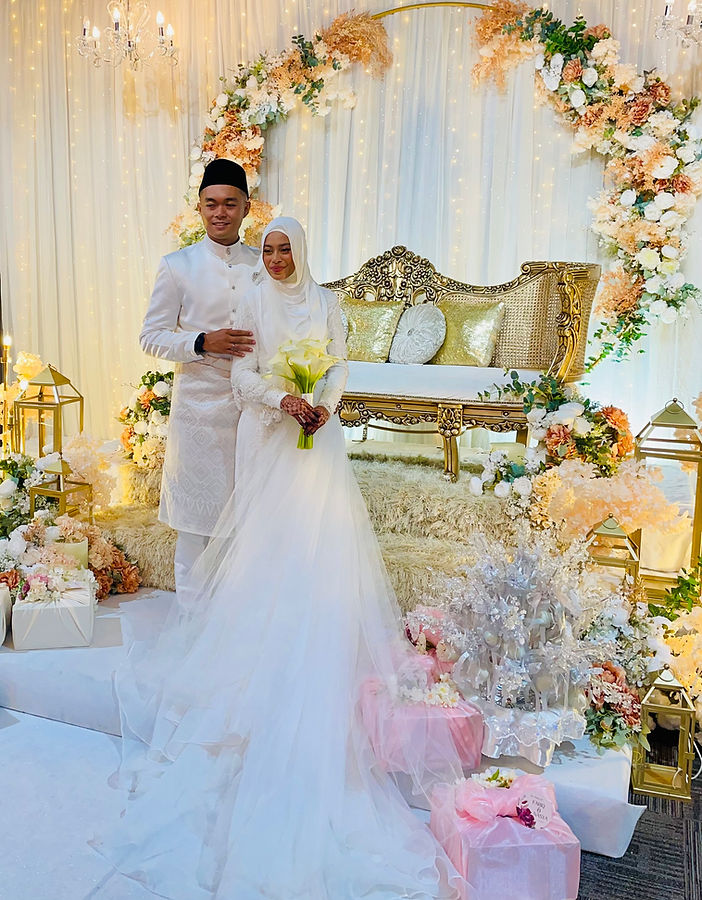
Hantaran trays display in two positions at Singapore venues. They either flank the pelamin (bridal stage) or sit on dedicated side tables visible from the main seating area. The sirih junjung occupies the centre or front position in every configuration. This placement signals its role as kepala hantaran. The remaining trays arrange in descending order of cultural importance from left to right.
Each tray requires one bearer during the procession. A 7-tray setup needs 7 bearers from the groom's side and 9 from the bride's. The total reaches 16 family members in matching outfits. Singapore mak andam typically coordinate matching baju kurung or baju melayu rental. Outfit cost runs S$50–S$150 per bearer in 2026.
The procession begins at the venue entrance and proceeds toward the pelamin. Photographers capture the procession from three angles: entry shot, mid-walk, and tray presentation at the stage. Venues with wider entrances and longer ballroom aisles produce stronger procession photography.
How De Hall Hosts Hantaran in Its Tai Seng Ballroom
De Hall operates an air-conditioned, alcohol-free ballroom at 3 Irving Road in Tai Seng Centre. The venue caters specifically to Malay Muslim weddings. It accommodates full hantaran processions with dedicated display tables flanking the pelamin. The bearer entry path runs clear from the venue door.
The venue offers three integrated services covering the complete ceremony. The list includes Full Wedding Package, Solemnisation, and Engagement Package.
Full details sit on the De Hall services page. Each package includes venue dressing coordination with the couple's chosen hantaran arrangement style.
For couples planning a complete Malay wedding sequence, De Hall's content library covers the full ceremony chain. The series includes bertunang ceremony, mak andam selection, pelamin setup, and ROM solemnisation packages. Compare De Hall against alternatives via the 15 best Malay wedding venues in Singapore 2026 guide.
FAQ: Hantaran Singapore — Questions Answered
Is hantaran compulsory in Islam?
Hantaran is not compulsory in Islam. It is a Malay cultural practice, classified as optional adat rather than religious obligation. Only mas kahwin (mahr) is compulsory under Islamic law. The groom must give mas kahwin to the bride. Singapore Muslim couples can complete a religiously valid marriage without hantaran. The cultural expectation in Singapore Malay families remains strong, according to Muslim.sg.
How much does hantaran cost in Singapore in 2026?
A standard 7-tray hantaran costs S$675–S$11,400 in Singapore in 2026. The range spans budget DIY (S$675–S$1,175), mid-range professional (S$2,025–S$3,525), and luxury gubahan (S$6,400–S$11,400). Wang hantaran (cash gift) sits separate and ranges S$6,000–S$15,000 based on historical Singapore data. Total budget depends on tray count, decoration tier, item quality and whether you use professional gubahan.
How many hantaran trays should I have?
The 7-tray configuration remains the most common in Singapore Malay weddings. It balances cultural completeness with realistic budgets. Five trays suit intimate weddings or budget-conscious couples. Nine and eleven trays suit larger or more established family ceremonies. The choice depends on family discussion, venue space, guest count and budget.
Why must hantaran trays be odd numbers?
Hantaran follows the odd-number rule (5, 7, 9, 11) due to two reasons. Islam carries a documented preference for odd numbers in sunnah practice. Examples include eating dates in odd numbers, witr prayer, and tawaf circumambulations. Malay adat additionally treats odd numbers as symbols of unity that cannot be divided. Even-numbered hantaran has no precedent in Singapore Malay practice.
What is balasan hantaran and is it compulsory?
Balasan hantaran refers to the bride's return trays — always two more than the groom delivered. If the groom presents 7 trays, the bride returns 9. The practice maintains balance between both families. It frames hantaran as a true exchange rather than one-directional dowry. Balasan is cultural custom, not Islamic requirement. Some 2026 Singapore couples skip it by mutual family agreement.
What is the difference between hantaran and mas kahwin?
Mas kahwin is the compulsory Islamic dowry paid by the groom to the bride. The bride owns it alone. Singapore's minimum mas kahwin stands at S$100. The Registry of Muslim Marriages records the amount during akad nikah. Hantaran is a separate optional Malay cultural practice. It involves decorated gift trays exchanged between families. A religiously valid nikah requires mas kahwin but not hantaran.
Do I need to register the hantaran amount at ROMM?
The Registry of Muslim Marriages records both mas kahwin and hantaran figures during the marriage application process. Mas kahwin is a mandatory field tied to Islamic law. The hantaran field captures the cultural gift amount agreed between families. Couples should confirm exact 2026 ROMM field requirements directly via the official Registry of Muslim Marriages portal.
Plan Your Hantaran and Wedding Ceremony at De Hall
Singapore Muslim marriages declined 3.9% from 5,396 in 2023 to 5,184 in 2024, according to the Department of Statistics. Yet couples who do marry now invest in better-planned ceremonies. Hantaran sits at the centre of that ceremony. The right venue makes the difference between a procession that flows and one that feels rushed.
De Hall's air-conditioned ballroom in Tai Seng accommodates full hantaran processions. The layout includes bearer entry paths and pelamin-adjacent display tables. The Full Wedding Package, Solemnisation and Engagement Packages each integrate hantaran display coordination. Book a free consultation to walk through the ballroom. Request a written quote tailored to your tray count and guest list. Reach the venue directly at 9855 3027 or enquiry@dehallsg.com.




Comments